

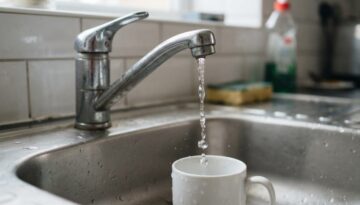
Why Did Your Water Pressure Suddenly Drop in Your North Vancouver Home?
A sudden drop in water pressure across a whole North Vancouver home usually points to one of four things: a failing pressure reducing valve, a partially closed main shutoff, a hidden leak somewhere in the supply line, or work happening on the municipal main. If the drop is at one fixture only, the cause is almost always a clogged aerator or cartridge instead. At The Good Plumber, we treat a sudden pressure change as a diagnostic signal rather than a nuisance, because it often arrives before the leak does.
The key question to answer first is whether the change affects the whole house or a single tap. That one distinction eliminates most of the possible causes.
Is the Low Water Pressure Affecting the Whole House or One Fixture?
Start by testing three or four taps in different parts of the house, hot and cold at each. If every fixture is weak, the problem is upstream, somewhere between the city main and your distribution piping. If only the kitchen tap is weak, the problem is at the kitchen tap.
Single-fixture low pressure is usually a clogged aerator, a failing cartridge, or a partially closed supply valve under the sink. Unscrewing an aerator and rinsing out the mineral debris solves this more often than people expect.
Also check whether the drop affects hot water only. Weak hot water with normal cold pressure usually points at the water heater, its shutoff valve, or sediment restricting flow rather than at the supply into the house.

What Is a Pressure Reducing Valve, and Why Does It Fail?
A pressure reducing valve, or PRV, is a device installed near where the water service enters the home that lowers incoming municipal pressure to a safe level for household plumbing. The BC Plumbing Code requires one where static pressure may exceed 550 kPa, about 80 psi, in areas that may be occupied.
PRVs are mechanical, with an internal diaphragm and spring, and they wear out. When one fails, it fails in one of two directions. It either drifts closed and strangles pressure across the whole house, which is the version most homeowners notice, or it drifts open and lets full municipal pressure into the home, which is quieter and more damaging.
The second failure mode is the one worth understanding. Excess pressure shortens the life of every appliance connected to your plumbing: the water heater, dishwasher, washing machine, toilet fill valves, and every supply line in the building. It also raises the odds of a failure at a joint you cannot see.
Most PRVs are serviceable or replaceable without touching the rest of the system, and they are not an expensive component.
Book a plumbing repair visit to have your pressure tested and your PRV checked.
Could a Hidden Leak Be Causing the Pressure Drop?
Yes, and this is the possibility worth ruling out quickly. A supply line leaking underground, inside a wall, or beneath a slab bleeds off pressure continuously, and the pressure change is often the first symptom a homeowner notices.
There is a simple test. Turn off every fixture and water-using appliance in the home, then check your water meter. If the meter is still registering flow, water is going somewhere. Many North Vancouver homes have a small leak indicator dial on the meter that turns with even minor flow.
Other signs worth noting: an unexplained jump in the water bill, a warm patch on a floor, the sound of running water with everything off, or an area of the yard that stays green and soft through a dry stretch. A hidden leak that opens up fully becomes a burst, and the first 10 minutes of a burst pipe are worth knowing in advance.
How Does The Good Plumber Diagnose a Pressure Problem?
Diagnosis starts with an actual pressure reading at a hose bib, not a guess. A gauge reading tells us immediately whether the system is under-pressured, over-pressured, or normal, and that single number redirects the whole investigation.
From there it is a matter of isolating sections: testing upstream and downstream of the PRV, checking the main shutoff is fully open, reading the meter with everything closed, and inspecting visible piping for corrosion or restriction.
Jamie Pender, owner of The Good Plumber, has spent more than 20 years serving across the North Shore, and the company is BBB A+ accredited and rated 4.9/5 on Google. Contact us now if you experience sudden drop in water pressure at your home – (778) 720-5958.
Frequently Asked Questions
What is normal household water pressure in British Columbia?
Residential plumbing is generally designed to operate below 550 kPa, about 80 psi, and the BC Plumbing Code requires a pressure reducing valve where static pressure may exceed that in occupied areas. Comfortable working pressure for most homes sits well under that ceiling.
How long does a pressure reducing valve last?
PRVs are mechanical wear items and commonly need attention after a decade or more of service, though water conditions and how hard the valve works affect that. Gradual pressure changes in an older home are a reason to have the valve tested.
Can high water pressure damage my plumbing?
Yes. Pressure above the code limit shortens the life of water heaters, dishwashers, washing machines, toilet fill valves, and supply lines, and increases the chance of a joint failure inside a wall.
Why is only my hot water pressure low?
Low hot water pressure with normal cold pressure usually points at the water heater, its shutoff valve, or sediment restricting flow, rather than at the incoming supply. It is worth checking the tank rather than the main.
How do I know if I have a hidden leak?
Shut off every fixture and appliance, then watch the water meter. Movement with everything closed means water is escaping somewhere in the system.


